What Does 'Extra 50% Off' Actually Mean? I Did the Math on Five Labor Day Banners
Gap hung three Labor Day banners on one page this week. J.Crew hung one, with an asterisk. Anthropologie's says 'up to.' On September 3 I copied every number down, followed each one to the rack it points at, and multiplied. The discounts don't match the font sizes.
 ·
· 
Start with $168. That’s the first price printed under the Pilcro Greer denim midi shirtdress on Anthropologie’s Labor Day rack, the one the site headlines “Up to 40% Off Clothing & Accessories”. The second price is $117.60. Divide and you get 30% off, not 40. And then the chain stops. No third number is coming for that dress, because the fine print on the promotions page says “prices as marked” and “cannot be combined with other promotions.”
I spent the morning of September 3 collecting numbers like these, because the long weekend has produced a genuinely confusing crop of them. Gap’s own homepage is running three banners at once: “40–60% off select styles,” “extra 50% off sale,” and “50% off all sweats.” J.Crew’s says “40% off your purchase*”. Good Morning America’s roundup, published September 2, adds Banana Republic at “up to 50% off, plus take an additional 20%,” Abercrombie at “up to 40% on almost everything, plus an extra 20% off clearance,” and Lee at “take an extra 50% off sale styles.” I haven’t bought any of it, and none of these numbers can tell you whether the sweater is good. What they can tell you, once you multiply, is which banner is actually the biggest, and you can’t get there by reading, because three little words are doing all the work: “extra,” “up to,” and “purchase.”
What does “extra 50% off” take 50% off of?
An “extra 50% off sale” takes half off the current sale price, not the original, so at Gap a $128 sweater already marked 40% down to $76.80 becomes $38.40, which is 70% off the first number on the tag. Not 90. Stacked discounts multiply what’s left of the dollar. The first cut leaves 60 cents, the extra 50 leaves half of that, 30 cents, and 30 cents on the dollar is a 70% discount no matter how loudly the two banner numbers seem to add to more.
There’s a small paradox buried in that math, and I find it clarifying. On that $128 sweater, the 40 removed $51.20. The extra 50, the bigger number, removed $38.40. Each new percentage works a smaller room. Every “extra,” “additional,” and “take another” you’ll see this weekend obeys the same rule: it sounds like addition, it behaves like multiplication, and multiplication is always the smaller answer.
Gap, multiplied out
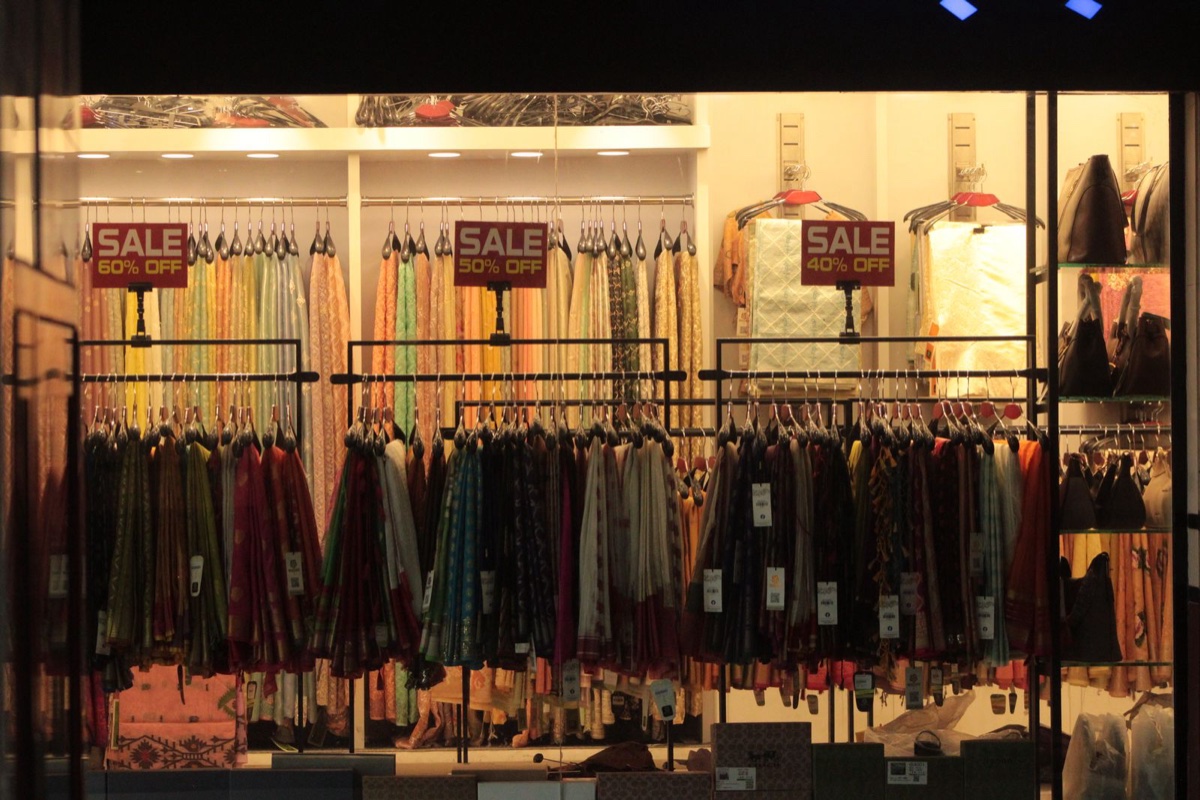
Gap’s three banners describe one event with three different chains. “40–60% off select styles” is chain one, a single cut. “Extra 50% off sale” hangs the second link: a sale style at 40% off lands at 70% off original, and one at 60% lands at 80%. That 80 is the deepest arithmetic I found on any mainstream banner this weekend, and notice that it’s built from the two smallest fonts on the page. There’s even a fourth link if you want it, an “extra 20% off your first purchase” with the store’s new credit card, which multiplies again rather than adding, though a card application is a strange thing to price a cardigan with.
One honesty note: Gap’s banner links to a details page that a static read won’t expand, so I can’t show you a single garment’s full chain the way Anthropologie’s tags print theirs. The multiplication is verifiable. The checkout screen, from here, isn’t.
J.Crew, multiplied out
J.Crew’s chain has one link, and it’s the whole store. “40% off your purchase*. Online only. Prices as marked. Exclusions apply.” The asterisk earns its keep somewhere in those exclusions, but the grammar is the cleanest of the weekend: no “extra,” no “up to,” and the rack it covers is the full-price wall rather than the clearance corner. On September 3 the homepage was showing a $98 vintage-wool V-neck at $58.80 and the $248 Margeaux blazer at $148.80, both printed as flat 40s. What you see is what comes off. Forty is the smallest headline of the three stores here, and the only one that means exactly what it says. Last year’s banner roll sorted these same events by which rack they actually cover, and J.Crew’s grammar hasn’t moved since, so this reads as house style, not a 2026 mood.
Anthropologie, multiplied out
Anthropologie’s grammar is “up to,” and “up to” is a ceiling, not a promise. I counted the Labor Day rack itself: of 71 clothing and accessory items showing paired prices on the morning of September 3, 45 printed exactly 30% off, 20 printed 40%, and 6 sat at 20 to 25%. So the headline number covers 28% of the rack it advertises, and the modal experience is a dress like the Greer at 30. The store’s regular sale section runs looser, 68 items spread from 11% to 78% off, with exactly 6 of them at half off or better.
The extra grammar does visit this store, just not this weekend. In March 2025 the same promotions page carried “Extra 40% Off Sale Items, Final Sale,” per the Internet Archive’s copy of it, and the standing policy still spells out the toll on that second link: “All sale items ending in $.95 that are purchased at an additional sale-on-sale discount and marked ‘Final Sale’ cannot be returned or exchanged.”
Read that twice. The deepest chains and the no-returns tag are the same tag.
To be fair to the stacked banners, they’re where the weekend’s real depth lives. Nothing on a single-cut rack this week touches Gap’s multiplied 70 to 80. If you know the original price, know the final price, and won’t need the return window, sale-on-sale is where the deep numbers are honest. The whole crop, in one place:
| The banner, as printed | The rack it covers | Adds up to, in your head | Multiplies out to |
|---|---|---|---|
| Gap: “40–60% off select styles” + “extra 50% off sale” | Sale styles | 90% and up | 70 to 80% off |
| Banana Republic: “up to 50% off, plus an additional 20%” (per GMA, Sept 2) | Sale styles | 70% | 60% ceiling |
| Abercrombie: “up to 40%, plus an extra 20% off clearance” (per GMA, Sept 2) | Clearance | 60% | 52% ceiling |
| J.Crew: “40% off your purchase*” | Full-price store | 40% | A true 40% |
| Anthropologie: “Up to 40% off clothing & accessories” | One curated rack | 40% | 30% on 45 of 71 items |
Is 50% off half price?
One 50% off is exactly half price, and two 50s stacked make 75% off, not 100, because the second half comes out of a smaller pie. That’s the entire trick, and it converts every banner this weekend into one portable rule: ignore the percentages and divide the last price by the first. If a tag prints both, you don’t need the banner. If it prints only one, keep your card in your pocket until you find the second, because a percentage with no anchor price is decoration. The same divide-first routine held up on Zara’s tiers in August, where 33 of 33 “Special Prices” items came out at exactly 40%.
And if mental math is the part you hate, you can skip every multi-number banner without missing much. J.Crew’s flat 40 is the weekend’s no-arithmetic option, Gap’s stack is its deep one, and on the $168 Greer, Anthropologie’s whole event comes to $50.40.